Showing posts with label Culture. Show all posts

Sunday, March 31, 2013

International Living in the Middle of the USA


So I had a few more posts planned out for my series on religion in a cross-cultural relationship, but I've decided to forgo that route and discuss something different. 

On this Easter weekend here in the US, Facebook was a buzz with pictures of cute kiddos hunting for Easter eggs, pictures of bunnies and spiral ham dinners - American traditions.  We unfortunately missed the Easter church and dinner celebrations with my family due to work obligations, so we missed out on the American traditions, but we were still enjoying the weekend and the beginning of spring weather (finally!) with the windows open.  The shrieks, giggles and voices of the neighborhood children floated through the dusty screen and beckoned me to come watch the group playing down below.  There were six or seven kids of various ages running around.  There were a few older kids - maybe 7-9 years old and a few younger ones (< 3), but they all seemed to play together without drama.  Oh - and they probably represent about 4-5 different countries.  H. lives in the international family housing on his campus and diversity is never in short supply in this neighborhood. 

Just walking down the outdoor apartment walkway one can savor the scent of curry simmering on a stove, and almost taste the garlic frying in several kitchens.  My mouth waters every time I step outside.  Next door is a Malaysian family, downstairs is a family from Nepal, at the end of the hallway a couple and toddler from Afghanistan, in between there are few families from China, around the corner 3-generations of Lithuanians.  Yes, I can easily say that H.'s apartment is the most diverse living space I have ever had the privilege of residing in.  I can only imagine what it must be like as a child.

Saturday, as I stood at the open door, watching the children playing in the grass below, I heard one of the older boys ask another little boy with a bit of aggression "What are you doing?"  The inquisitor was definitely the leader of the group.  The other boy was squatting in the grass, picking pieces of grass, or twigs - something like that.  "I'm getting ready for Easter." He replied.  "Easter isn't until tomorrow"  the slightly aggressive inquisitor responded.  "Well, in my country we gather plants and we make a basket for the eggs, so I'm gathering some plants to make our baskets."  The boy replied with the most matter-of-fact, non-combative tone. 

I smiled.  "In my country…."  The boy had said the phrase with perfectly American-accented English.  There was no hint as to what "my country" could be referring to, although we knew that he was from Lithuania.   I imagined how many other moments like this occurred throughout the evening playtime.  How many small bits of culture were shared back and forth.  These children, I thought, will grow up with a greater understanding of diversity, hopefully more compassion and tolerance, and a huge amount of intellectual stimulation from interacting with so many different types of people. 

"I wish our kids could grow up in a place like this."  I've shared with H. on more than one occasion.  To have the open space outside - a safe space, to play, to learn, to grow - what more could one wish for their child.  At the same time, I have often thought how difficult it must be for families to raise their kids  in such small, cramped apartments - 4 bodies in a one room apartment or 3-generations (including 3 kids) in a two bedroom set-up.  The closeness of family beats out comfort in many cultures, and one can see this first hand in this little international community.

Diversity.  It's priceless. 

Another example: today is Easter for all Christians (and Happy Easter if you celebrate!), but here in this apartment community, a group of Indians were celebrating Holi - the Indian festival of color.  We heard the Indian dance tunes and the crowd screaming from a quarter mile away, so we went over to see what was happening.  Pink, purple and orange dust covered the concrete sidewalk and a big pink, purple, orange dancing mob was enjoying the day.  H. was immediately greeted by a friend who put a large orange smear on H.'s forehead.  Soon after a little blond girl threw some purple dust on me.  Then an Indian lady came and added a few handfuls of pink and purple dust to my cheeks, neck and hair.  Now I looked like I belonged at this party.  We didn't stay for long,  as the event was winding down, but  long enough to savor the joy. 

Holi is something like this.  From TheExaminer.com

I can honestly say, the absolute best aspect of living in the United States is this diversity.  It can't always be found everywhere and the interactions are not always pretty, but there are many beautiful moments.  Even in this small Midwestern town (albeit with a big university) you could represent the majority of the globe with the many different faces and races.  It is a beautiful thing.

Thursday, January 31, 2013

Detour to Castles, Caves and Cool Mediterranean Waters


Today is probably one of the coldest days of the year so far in this Midwest state full of manic weather.  Currently it's 14 degrees Fahrenheit (that's  -10 in Celsius) and 2 degrees F with the windchill - brrrr!  So with my wool hat and gloves still on in my chilly, old apartment -  I'm dreaming of warmer days.  In fact, earlier today I found myself flipping through pictures from my first trip to Turkey in the early summer of 2011. So I couldn't help but take a short detour from my planned posts and instead, I took a warm trip down memory lane to the region of Mersin, a lovely spot on the Mediterranean Sea.  

On our short trip to Turkey in 2011, we decided that we had to get a taste of the salty Mediterranean air and see the various shades of blue of that great Sea.  From Maraş we drove down through Adana to visit a professor from H.'s college days and then we continued on through Mersin and into the surrounding coastside full of small resorts, swimming holes, caves, and of course, scattered with historical monuments.

The crystal water is calling to me - even though it was freezing cold at the time.
The blue gives the allusion of warmth doesn't it?

We spent several hours swimming in the aquamarine waters and sunbathing on the rocks at a local swimming spot.  Next, we drove back in the direction of Mersin to stop where the ancient city of Koryos once stood and where the Kız Kalesi, or Maiden's Castle, now remains. 

Several crumbling parts of the land castle.
 Koryos dates back to the Hellenistic period in the 2nd century BC.  During the reign of the Byzantine empire in the 12th century, both the land and the Maiden Castle were constructed.  The legend of the Kız Kalesi is strikingly similar to that of the Kız Kulesi in Istanbul (kule = tower; kale = fortress or castle), in fact, the stories are exactly the same.  A king hears from a fortune teller that his daughter will be poisoned by a snake.  In an attempt to sidestep fate, he has servants build a castle on an island and he keeps his daughter there.  Only, one day, a snake makes it into a grape basket that is brought to the castle and the daughter is bitten and dies.  (I'm wondering - is this just a favorite legend to accompany buildings built in the sea or what is the historical reality of these matching stories?)

The Kız Kalesi in the background, as seen through a window in the land castle.
 The Kız Kalesi and remains of Koryos are perfect examples of overlapping cultures, a common phenomenon in Turkey.  The stones of the castle are said to come from buildings of the Roman period and the area is full of historical hot spots, such as a local Roman temple, necropolis, church and cistern.  Right across from the castle there are exposed stones with distinct figures etched into the mammoth rock.  I'm not sure what culture or time period these figures belong to, but there they are nonetheless.  Another example of how you can't walk down a path in Turkey without stumbling over an ancient artifact.

A view of the coast and local village from the top of the castle wall.

If you head straight up the hill from the castle you will find some of the remains of the Roman buildings and another natural and human spectacle, fittingly called by the locals, "Heaven and Hell", and on the tourist brochure, "Heaven Hollow", or in Turkish, Cennet Obruğu.  To access "Heaven" you must follow 455 steps down a steep incline.   

Just the beginning of the 455 steps.

The mouth of this hollow is 200m wide and the deepest point is 70m below ground - so don't wander too far without a flashlight!

Halfway down the steep pathway we stopped to explore the Virgin Mary Chapel, a small stone chapel dating to the 5th or 6th century AD.  The chapel is supposedly decorated with frescoes of Jesus and his 12 apostles, but all I could see were the etchings of many travelers before me that had felt the need to leave their mark in stone. 

Photo op inside the Virgin Mary Chapel, clouded with graffiti on the chapel walls.
(Photo copyright of hakanirfan @ flickriver.com/photos/hakanirfan)
 Past the chapel it's straight down, into what feels like hell, and not heaven.  We crawled, not walked, down into the gaping hole, scattering pebble from the path and sliding over slimy rocks.  As we made it further inside the hollow, mud was haphazardly streaked across our bottoms and legs as we used all of our body to balance and brace from the forces of gravity in the near pitch blackness.  We enjoyed  a few moments inside the dark and eerie quietness of "heaven" before we were joined by a boisterous group of about 30 students studying tourism at the local university.  I was greeted in several languages as they blinded me with their flashlights and tried to guess what nationality I belonged to.

The incoming as seen from inside the cave.
(Photo copyright of hakanirfan at 
 @ flickriver.com/photos/hakanirfan)
Then we crawled back out of heaven - never quite finding hell - and not sure if that was perhaps where we had been.  But then we realized, the hell is walking back up those 455 steps!  So that was why the locals called it "Heaven and Hell" but the tourism plaque only mentions the delightful "Heaven Hollow" - sounds much better doesn't it?

After we drove around a bit, we did find a bit of heaven at a quaint restaurant serving gözleme and fresh, frothy ayran with a view overlooking the city and Mediterranean Sea below (and a few ornery and sad camels trying to escape from their shackles).  Yes, I guess every bit of heaven has its dark moments.  A good lesson in life, really.
The sad camels meant to please tourists. 

So now I emerge back from my walk down that sunny, but at times dark and damp, memory lane to winter in the Midwest, USA with enough warmth inside me to keep me fueled during the busy months ahead and with the hope for many more warm, sunny days in Turkey this upcoming summer when we finally get our balayı (honeymoon).


Tuesday, January 22, 2013

Treats from Turkey


Living in a highly globalized country full of imports from around the globe (I'm talking about the USA), one would think that any desired commodity can be found - if not in stores, then at least online.  While that is partially true, the reality is that while we have access to almost everything, the quality of these commodities are questionable at times.  With Turkish products this is especially true.  We can find Turkish ingredients and treats at the local Mediterranean or International Markets, yet we have been burned many times by overpriced, expired goods that just do not taste right.  Other times, ingredients may seem to be Turkish, but there is some additional flavor added to compliment tastes preferred in Arabic or Persian culture. 

So before traveling to Turkey we brainstormed some of the things we would want to bring back with us, and then while in Turkey that list continued to grow as our taste buds were reminded of the glorious pistachios, fragrant teas, and tantalizing Turkish delights that we had been missing.  So we stuffed our luggage as full as possible with these small Turkish treats to enjoy once back at home.


Locally roasted pistachios from Maras - gifted to H. by his sister 


The perfect Turkish Delight or Lokum

We've already made our way through one box of the pistachio Turkish delights and we're working our way through the second.
  These are not your typical Turkish delights, instead of the white powder, they are covered with powdered raw pistachio.  The flavor is rich with just the right amount of sweetness. 

A collection of Koska sweets to give as gifts (or maybe just eat ourselves if we get greedy)
 We've also been enjoying glass after glass of the Turkish herbal tea - like elma (apple) tea and kuşburnu tea, a combination of rosehips and hibiscus that is tart like cranberry juice.  It's the perfect way to keep warm and snuggly without the caffeine of black tea on these cold winter nights.  We love it so much that we found a website where we can order more boxes when we run out. (http://akmarket.com/  This website is also great for ordering all sorts of Turkish food - like cheese, socuk and sweets, even baked goods!)

In order to keep up the alaturka cuisine in the kitchen, I stocked up on some of the most useful spices for Turkish cooking.  Susam (sesame seeds) and Çörek Otu (Cumin seeds) can both be found in the US, but for a pretty penny.  These seeds are essential for a lot of Turkish pastries, such as börek and Turkish scones, and if I get up the gumption, I may try to make simit, Turkish bagels loaded with sesame.  

Collection of Turkish spices
Köfte Baharı is a useful addition to ground beef to make a quick and tasty hamburger or köfte on the grill.  I have fallen in love with the taste of Kuş üzümü (dried currants) in rice pilaf and I'm looking forward to trying out this simple twist sometime soon.  Pul biber (red pepper) is essential for Turkish cuisine and nane (dried mint) was so essential that the package was already in use before I could take this photo.  While I'm sure spices directly from the bazaar would have been the best quality, we opted for the packaged variety for easy transport and ease during customs. 

Now, for some of the fun stuff.  Before our trip there were several things I knew I was going to bring back just because I love them so much.  I was eager to get a Turkish tea glass set, because tea just tastes better in those tulip shaped glasses. Turkish tea glasses can also be found in the US at stores like World Market (where they are sold as shot glasses ????) and international grocery stores.

My new Turkish tea glasses (NOT shot glasses, World Market) 

 After the last trip when I was gifted a beautiful Turkish scarf with oya, handmade flower lace, I planned to buy these scarves to bring back as gifts.  So one Saturday we ventured out in the rain to the local bazaar to find the one lady who sold these beautiful treasures made by a local women's artisan groupIn Turkey, oya scarves are most commonly worn as head scarves.  In Maras, you can see the young and the old wearing these beautiful scarves, yet it is becoming less common that the young generation will wear such a traditional scarf.  I like to wear them around my neck in a variety of different styles.  I love the lightness of the fabric and how soft it feels.  I often find myself admiring the small lace flowers and wondering how they could possibly be made by hand - a true Turkish treasure.

Two examples of oya lace
While the selection is much better in Turkey, these scarves can be accessed in the US also.  Just a visit to Etsy (a handmade and vintage online community of stores) and search for "oya" will return hundreds of examples.  Many are created with Western appeal in mind, and others state that they are straight from a bridal chest and never worn (which I find quite sad).  Yes, the oya scarves and the bridal chest have an important role in Turkish wedding traditions, so perhaps it's best I save this topic for a different blog post.

Here are a few of the oya scarves that I picked up.

I chose a few of the darker ones as these will be gifts for older relatives of mine, but there were many different options in all the colors of the rainbow.  I might have to stuff my suitcase with more on the next trip.

Sunday, January 6, 2013

Santa Claus, New Years and Commercialization in Turkey


This year was my first time spending Christmas away from my family.  In fact, I didn't celebrate Christmas at all.  While I missed the family time - seeing relatives and eating lots of food - I did not miss the gift exchange.  For the most part, I already gave my Christmas presents and I gave many presents here in Turkey, so I felt the joy of giving that is so much fun around Christmas.  What I didn't experience was the stress of shopping last minute, or of disappointed looks from presents that just weren't quite right. 

I expected that Christmas would not be celebrated here in Turkey.  At least not in the main stream society that is predominately Muslim.  However, it seems that Christmas is perhaps more of a capitalist conception that a religious one (or at least in its modern form of gift giving galore).  Since I arrived in Turkey I noticed Christmas decorations in several shops.  Commercials were full of red and green sparkling trees and lights with the message to give gifts, shop the sales and use your credit card!  When I asked about this I was told that these images are related to New Year's here in Turkey.  So it seems that the color and flamboyance of modern Christmas has infiltrated the closest secular holiday - the New Year celebration.

Christmas decorations for sale in a department store in Maraş
(Source: Turklish)

Christmas decorations sold in Istanbul
(Source: http://www.hurriyet.com.tr/english/domestic/10641094.asp)

Even some of the Turkish television series picked up on the theme.  Back in the USA we watch Yalan Dünya, a comedy that contrasts a traditional Turkish family with a group of actors living in side by side apartments in Istanbul.  Most of the Turkish is over my head, but with H.'s lighting fast translations, I can get the general picture and some of the jokes.

This past week we were watching the New Year's episode and we were both a bit shocked.  It took the shopping theme to the max including all the drama related to gift exchange - the need to impress with the value of the gift, the wife mistaking a gift for her husband's mistress as her own, and the stress of shopping in the crowds.  

Santa Claus even made an appearance on the show.  Santa, as many of you may already know, is from Turkey!  Now, I'm not talking about the big-bellied, red and white clad, ho-ho-ho fellow.  I'm talking about the real Santa - St. Nicholas, who was born in the third century in the Greek village of Patara, which is now located on the southern coast of Turkey.  St. Nicholas sold what he owned to give to the poor and became well known for his generosity to those in need. 

I'm not sure how such a compassionate man who cared so much for the poor became the symbol of excess and gluttony at Christmas, but culture works in strange ways.  Perhaps it was that clever parent that told their children they would get gifts if they were good or coal if they were bad from good ol' St. Nick.  Just as parents use the "elf-on-the-shelf" technique these days.

One image of St. Nicholas that doesn't fit the modern depiction.
(Source: http://www.rnw.nl/english/article/turkey-demands-st-nicholass-bones-back)

However it happened, now St. Nicholas, or Santa, is the symbol of the commercialization of Christmas - and now apparently for New Years in Turkey too!  In the episode we watched Santa was outside the stores encouraging people to come and buy gifts and spend money.  One of the down-to-earth characters in the series, who represents a man from the North of Turkey, walks up to this Santa and says - "what are you doing? Santa isn't like this, he's a brother from Turkey, he gave to the poor not the rich".  Soon the man shows up in a brown robe with a drum - the real "Santa".  They fight for attention in the street as the confused shoppers wonder by.

A screen shot from the Yulan Dunya series with dueling Santas - the one on the left is a depiction of the historical St. Nicholas, while the one on the right, I believe, needs no introduction
(Source: Turklish)

In another scene an older man in the traditional family scolds his son-in-law for buying inappropriate gifts for the neighbors.  He says - "In our culture we give to the poor on holidays - not buy underwear for our neighbors." 

Good point.  For most of the religious holidays in Islam, gifts of meat or grains are given to the needy, and to family and neighbors.  Useful gifts - like lamb and bulgur.  Of course, the children get their candy too. 

It seems with this New Year's gift giving tradition that someone is trying to change Turkey little by little to be more like America (or Western Europe).  Or perhaps it is just capitalism and globalization at work.  For you see, commercials are just distractions without the song and dance of the holiday and sales seem like much better deals when you are in a rush to buy something in time for a holiday.  The obligation to buy gifts for others in time for New Year's Eve will surely boost revenue at all the clothing and department stores.  So maybe all this commercialization of New Year's is good for the economy, but what about the cost to culture?

At least I can say that this tradition hasn't infiltrated into H.'s family.  We spent New Year's Eve eating delicious food, drinking glass after glass of tea, and singing Turkish folk songs until the moment the clock struck midnight and then we ate desert.

Maybe these gift giving traditions are more common in Istanbul or Western Turkey, or perhaps the TV series are trying to get some extra sponsors by pushing gift giving from certain stores and brands.  I guess only time will show if this Western tradition will truly stick.  I'm hoping that it doesn't.

Does anyone else has any experiences or thoughts that may help clarify this Christmas-New Year's cultural conundrum?


Sunday, December 2, 2012

Hot Pink Fingernails and Lessons Learned


Act like the sun in love and compassion!
Act like a river in friendship and fraternity!
Act like the night in covering the faults of others!
Act like the soil in humility and selflessness!
Act like dead one in anger and furry!

Either act in accordance with the way you look,
or look in accordance with the way you act!

(Either exist as you are or be as you look.)


Rumi's wisdom lives on and on through his poems and famous quotations.  This poem speaks to me on many levels, but the last line is critical to the topic at hand.  "Either exist as you are or be as you look", which I would summarize to - just be yourself!!

While I would not call myself a "girly girl" I do try to look put together and I enjoy  the occasional (i.e. once or twice a year) pampering manicure.  Before my first trip to Turkey I was running around ragged with split-ends and hang nails.  I had read in Turkey - Culture Smart!  that "When wearing sandals, toenails should be neat and clean.  Turkish women love to have manicures and pedicures." I wanted to make a good first impression, so I thought I'd get myself a little dolled up with a manicure and pedicure the morning before my flight.  I even splurged and did a gel manicure, which stays on for a couple weeks without chipping. 

Oh, but what a mistake that was.

With very limited color choices in the gel nail polish, I tried to find a tasteful pink.  The bottle was no indication of the color inside.  I started to sweat as the manicurist applied the first coat.  I respectfully asked her to switch to a different color after one coat of the first horrid pink.  It was not any better.  I ended up with Barbie-hot-pink fingernails.

The only evidence I have of my poor color choice.  In all the other photos my hands are either strategically behind my back or folded to hide my nails.  
On the drive to the airport I explained to my mom what happened and how I really didn't want to have hot pink fingernails.  "Can you just take it off real quick?"  She asked me.  That was my indication right there of how bad it was - and no, I couldn't just take it off - gel nail polish has to be soaked in acetone for 15+ minutes!  We were driving to the airport!!  Plus, I'd just dropped $30+ bucks on those hot pink pointers, I felt like I needed to at least get a little wear out of them. 

"Well, it is early summer" my mom replied to my sigh, "pink is festive."  So I decided the pink would stay.

The rest of the trip I felt self conscious of these Barbie fingers that were not my own.  H. was even surprised - "why did you paint your fingernails that color? " he asked.  "You usually don't paint them at all."

"It was a mistake!!  And the Turkish culture book said ladies like to paint their fingernails."  I admitted.

I realized how ignorant that sounded the moment I said it - like a thin, 100-page book could really tell me all the cultural norms of a country.  As we went around town, and as we visited families, I noticed that most ladies did not have their nails painted on a daily basis.  In fact one young woman explained that her daughter's fascination with my neon fingers was because she never painted her own finger nails.

While a book like this can provide some solid information on basic cultural norms, it does not represent the many diverse facets of culture that constitute reality, which cannot actually be written in any one book.

I later learned, as the Turkish-Culture Smart! book failed to mention,  that Muslims have to remove their nail polish to perform the pre-prayer cleansing, called Wudu

As explained here in one of the steps:
Wash the right arm  up to  and including  the elbow.  Three times. 
The arm extends from the fingertips, including the nails, to the lower part of the upper arm. It is essential to remove anything stuck to the hands before washing them, such as dough, mud, paint, nail polish etc, that could prevent the water from reaching the skin.

Some Turkish women may paint their nails, some may not, and some may only spend the time or money very occasionally.  Culture is complex - and female fashion and personal preferences of an entire country can not be summed up into one paragraph in a tiny book.

From this experience I learned a lesson about reading too much into "cultural guidance".  I decided to just be myself.  Myself was just fine.

I also learned another lesson.  While I was stressing over how ridiculous I looked and imagining how all of Turkey was thinking I was a stereotypical blond, hot-pink inspired, American bimbo from American Pie - the reality was that no one really cared what my fingernails looked like.  No one judged me by my color mistake at the salon.  Whether I chose to paint my nails hot pink or bright red or black - they would not care.  They took me as I am - they saw through the colors of my hair, my eyes and my nails to see the real me.


Thursday, November 29, 2012

Planning for Two Weddings: The Cross-Cultural Couple's Dream (or Nightmare?)


I have started prepping for my upcoming trip to Turkey, and besides buying gifts, I'm starting to make a list of all the things I need to accomplish before I get on that plane, as well as everything I hope to do while in Turkey.

Besides work and school requirements that consistently hover in the background and foreground of my life, for the past several months wedding planning has really gotten underway.  I have many 'party-planning' duties (or decisions) I need to take care of here in the USA, and in Turkey as well.


Many little girls dream of their wedding day.  They may draw pictures of themselves as a bride in a beautiful, white princess gown, or imagine all the special moments, or start collecting items for their future home. 

I was not one of those little girls.

The only time I can recall my younger self dreaming about a wedding was after a trip to India.  "I want an Indian wedding!"  I told my mother after I came home.  The colors, the music, the procession, the henna night and the celebration - I loved this idea of a wedding.  But my destiny was not to have this type of wedding.  I am an American and thus American wedding it is (and now, a Turkish wedding as well - so I get my henna night after all!)

When I actually became engaged to H. and the prospect of planning a wedding became a reality, I told everyone "I just want a simple wedding".  Little did I know that my idea of a "simple wedding" was an oxymoron.  A true simple wedding would be driving to city hall and saying "I do" with two witnesses and a couple of signatures (which I have often contemplated doing in recent weeks). 

My false hope of simplicity was having a family affair, in an outdoor setting, with tasteful food and a informal attire.  It seemed so simple - as in "not fancy" - but the reality is "not fancy" does not equal simplicity.  There are so many details, so many decisions and so many expectations that come with a wedding.  Unfortunately, all of these many different components, along with my ill-defined concept of simplicity, have led to several explosions in the wedding planning process.

At this point I have come to terms that my wedding will not be simple, and I will have to compromise with family wishes for certain traditions and details that they feel are important.  I also have to accept that I am not so simple and that my family is not so simple as well - differing world views and values are at the core of many of our complications.  They are who they are, and I am who I am - but, in the end we all love each other and hopefully that is enough to accept was is.

Throughout this mentally-challenging American process I have held the hope that wedding planning in Turkey will be different.  (See we will be having TWO weddings…not so simple at all.)  As I have learned through H. and his family, wedding are typically at a local salon and that there are far fewer decisions that have to be made (as compared to American weddings).  The wedding is fairly standard with some minor personal details.  You see - I don't think they have The Knot, or all the thousands of wedding websites that explain just how important it is for you to personalize every wedding detail down to the cocktail napkins.
Cocktail napkins like these...

With a Turkish marriage there is more focus on "opening" a house or apartment.  The couple are moving in together and they need to create a home.  This home is prepared with all new furniture, appliances, curtains and all the appropriate accessories in advance of the wedding.  The night of the wedding, the couple arrive exhausted to their new home with a full fridge and all the details in place.   In Turkey, the real money is spent in prepping the house for a lifetime and not on flowers that die the next day or little matchbooks that say your name and wedding date for all the guests to take home and remember the special day. 

Well I guess I am blatantly showing my bias here (and overstating some of the details a bit, if I may). 

Through my experience thus far, I am realizing that the 'typical' American wedding is primarily a reflection of our consumer culture and an exaggeration of etiquette and tradition (the average cost of an American wedding is around $27,000!!!!!!).  But, but, but...perhaps it doesn't have to be so.  By trying to keep our purchases local and straightforward, H. and I are trying to needle out some of the blatant consumerism.  We are trying to keep the day real and true to ourselves, which means a little Turklish, with a combination of American customs and some added Turkish details. 

To be fair, our Turkish wedding may not be as easy and simple to plan as I am envisioning - I shall soon find out.

During our trip this December-January we will be making decisions with regard to our upcoming wedding - what food and beverages will be served, what invitations we will order, who will play the music, and more.  The "more" will hopefully not be too difficult.  At least I can sit back and ride through this one - my Turkish is in no condition for negotiations.   I'll let conventions be what they are and I'll keep the decision making easy and straight forward.  Or so I hope.

Sunday, November 25, 2012

Gift Giving and Packing for a Trip to Turkey

In about three weeks I will be getting on an airplane and heading to Turkey for a month-long trip.  Although I've already planned out (in  my head, of course) most of what I will bring, there are still some loose ends to tie up regarding gifts.

Tis' the season for gift giving so it shouldn't be all that difficult, right?  Black Friday was just a couple days ago and with Cyber Monday knocking on the door there are plenty of "super deals" out there to be had.  I've never played into these big shopping days and I'm fairly certain that it is all a scam, but the reality is that I do need to do some shopping fairly soon and I'm looking for ideas.
I love this!  Kudos to Owen Good at Kotaku for finding an old movie poster that seems to truly reflect the essence of the shopping Black Friday - "man-made monster is on the loose!"

"Why do I need to bring gifts?"  You might wonder. 

While some people in Turkey might celebrate Christmas (like Christians and ex-pats).  H.'s family does not.  Christmas will be just like any other day for them - except that H.'s nephew is turning two, so that should make it a fun, special day.

Gifts are not to celebrate any particular holiday, but instead are given as a response to warm hospitality.  Typical Turkish etiquette involves bringing chocolate or flowers to the host when invited for dinner.  On our last trip H. and I were invited to many, many dinners and breakfasts and afternoon teas and even for midnight fruit….    I loved it!  Meeting relatives and spending time eating good food with laughter all around - what's not to love.  Even though I only understood about 50% of what went on (and that was mostly due to H.'s translations) I enjoyed the atmosphere. 

I was prepared on that last trip with some local-themed gifts, but I did not expect to be getting gifts as well!  As our trip winded down and we were getting ready to leave, H.'s relatives surprised me with the most generous presents - many different locally made Turkish handicrafts - the best possible gifts for a girl like me.   I was taken aback by all the generosity - and this was aside from the overflowing hospitality I received throughout the entire trip. 

Now I am heading back to Turkey where we will attend wonderful family dinners and breakfasts and teas.  I am planning to head back with my arms full. 

I'm still brainstorming some good gift ideas.  Here is what we have so far: Ghirardelli chocolates, a combination of souvenirs that we have purchased on several trips in the past 18 months, some locally handmade gifts and toys for some of the young kids.

Despite the Italian name, Ghirardelli's is a true American company
(or as far as I could tell)
(Image from Ghirardelli Website )

I'm looking to fill up my suitcase - any suggestions?  


Tuesday, November 6, 2012

Making Manti


Turkish cuisine had me from my first taste of yogurt and mint - two ingredients that are very common in Turkish food and, for me, were not obvious plate-mates.  (Who knew yogurt and mint could be such a tasty combination?) 

I had my first real Turkish meal on my forth date with my now fiance.  In his tiny university apartment, with an economy-sized stove, he made me Yayla Çorbası (Yogurt Soup), rice pilaf, sautéed meat and vegetables, along with a crisp green salad dressed with lemon and oil.  We ate sitting on the floor leaning against an old couch his friend was "storing" there for the summer with our plates propped on the coffee table.  It was very grad school romance.  I loved every second of it. 

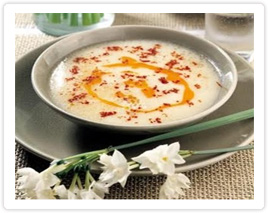
Yayla soup involves this surprising , and very Turkish, combination of yogurt and mint.  The ingredients are fairly simple - a small bit of rice, water, and then the base is yogurt, egg and flour.  The mint and Turkish red pepper are heated in a bit of butter and then added last minute to the soup as a sauce.  (The idea that soup has sauce was also a new idea for me - I remember thinking "how can soup have sauce? They're both liquid!" - it was incomprehensible until I saw it in practice).
A beautiful version of Yayla Soup
 (from http://www.acetestravel.com/Turkey-Recipe.html)

Yes, I am very lucky.  My Turkish man knows how to cook - and pretty gourmet at that.  In the past year or so, I have increasingly had the desire to boost my own culinary repertoire.  I've bought Turkish cookbooks, I follow several blogs written by expats in Turkey (see below for links), but there is nothing like face to face learning. 

During my stay this coming December and January in Turkey I hope to learn tips and tricks from H's mom and sister.  Until then, I'm taking advantage of Turkish cooking classes offered in my town. 

This past weekend I learned to make two Turkish staples:  lentil soup (with the red lentils), and baklava.  I already had experiences making both, but as with everything, there are many different variations and I learned a new way to make the Turkish-style lentil soup.   Though the star dish of the day was the very traditional Turkish dumpling called Manti.  There were six students in the class and two Turkish ladies instructing - and good thing, because we needed all the hands we could get to make these teeny, tiny Turkish dumplings (or also called "Turkish ravioli"). 

Piles of Turkish Manti!
(Source: Turklish)

We watched as the dough was kneaded and kneaded, with small spoonfuls of flour added until the dough bounced back when punched.  Then, after it rested, we watched as it was rolled again and again with a rolling pin about two feet long and the width of a broom handle.  The rolling was definitely an art - and none of us became artists on that day.  

Work in progress...
(You can see the small rolling pin in the middle of the table)
(Source: Turklish)

The experts did the rolling and we then cut the dough into one inch little squares and then added a small speck of meat-onion-parsley and pinched up the dough around the filling to make hundreds and hundreds of the tiny manti.

Lots of pinching meat and dough
(Source: Turklish)


Manti is traditionally a dish served during Ramadan.  Women get together in the weeks before Ramadan begins and spend the afternoon chatting and laughing while rolling and pinching little dough balls.  Then they save the joys of their labor in the freezer until the manti is brought out for a hearty meal to break the fast.

Manti is boiled in water and then the steamy plate of tiny dumplings are served with yogurt-garlic sauce, with a dash of tomato sauce and a sprinkling of mint and sumac.

Ta da!  A beautiful meal.
(Source: Turklish)


The results are as pleasing to the eyes as each savory little bundle is to the taste buds.

If you ever feel like taking on this culinary adventure - the recipe is below.  I recommend you at least recruit some fellow hardworking friends and family to help you with the manti making or you may be in the kitchen all day!


Turkish Manti:

For the dough:
4 cups flour
2 eggs
1 cup warm water
2 tsp salt to taste


·        Mix ingredients together and continue adding flour and water until dough bounces back when punched

·        Divide into 4 sections and roll out each section until uniform and thin

·        Cut into squares, about 1”

Filling:
1/2 lb ground beef
1 onion, finely chopped/shredded
1/2 tsp salt to taste
1/2 tsp black pepper
chopped parsley (flat Italian)


·        Put small bits of the mixture onto the dough squares and pinch closed to make the dumpling

·        Sprinkle the dumplings with flour to keep them from sticking to each other

For cooking:
8 cups water
1 tsp salt
Oil


·        Cook the dumplings in the boiling water until water is absorbed (~20min)

Sauces:
4 cups yogurt
3-4 cloves of garlic, minced
1/4 tsp salt to taste

·        Mix and add water until sauce has smooth, thin consistency


3-4 tbsp butter/oil
3 tbsp tomato paste 2 tsp paprika
2-3 tbsp water

·        Cook paste in oil and add water to make a sauce


Dried mint
Sumac


·        Spoon each of the sauces over the drained dumplings

·        Sprinkle the dried mint and sumac on top


Here are a couple blogs with great recipes for both Turkish and non-Turkish food:

My Turkish Joys - A blog written by an American expat and professional pastry chef living in Istanbul


Ozlem's TurkishTable - A website with recipes, and information about Turkish ingredients, cooking classes and culinary tours offered by this Turkish chef living in England. 


A Seasonal Cook inTurkey -  A blog by with regular updates of both Turkish and non-Turkish cuisine - lots of tasty looking cakes I would like to try!

Almost Turkish Recipes - Recipes by a Turkish student living in the states and providing her favorite Turkish and Almost Turkish recipes.


Related Posts Plugin for WordPress, Blogger...